Sr Software Engineer: Role, Skills & Career Path 2026

Discover what a sr software engineer does, essential technical skills, leadership responsibilities, and career progression strategies.
The sr software engineer position represents a critical inflection point in a developer's career trajectory. This role bridges the gap between individual contribution and technical leadership, requiring not only advanced coding proficiency but also architectural decision-making, mentorship capabilities, and strategic business alignment. Understanding what distinguishes a senior engineer from their mid-level counterparts is essential for both professionals seeking advancement and organizations building high-performing teams.
Defining the Sr Software Engineer Role
A sr software engineer operates at the intersection of technical execution and strategic planning. Unlike junior or mid-level developers who primarily focus on implementing features within defined parameters, senior engineers design systems, establish coding standards, and make technology choices that impact product scalability and team velocity.
The responsibilities of a sr software engineer extend beyond writing code. These professionals architect solutions that address both immediate business requirements and long-term technical debt considerations. They evaluate trade-offs between development speed and system maintainability, often making decisions that influence product direction for years.

Core Technical Responsibilities
Senior engineers own entire features or system components from conception through deployment. This ownership includes:
- Architecture design: Creating scalable, maintainable system architectures that support business growth
- Code quality enforcement: Establishing and maintaining coding standards through reviews and automated tooling
- Performance optimization: Identifying bottlenecks and implementing solutions that improve application responsiveness
- Security implementation: Integrating security best practices throughout the development lifecycle
- Technical debt management: Balancing feature development with refactoring efforts
These responsibilities require deep technical knowledge across multiple domains. A senior engineer working on web applications must understand frontend frameworks, backend services, database optimization, caching strategies, and deployment pipelines. This breadth of knowledge enables them to make informed decisions about technology stack selection and integration approaches.
Essential Technical Skills for Senior Engineers
The technical skill set required for a sr software engineer position has evolved significantly in 2026. While programming language proficiency remains foundational, the role now demands expertise across distributed systems, cloud platforms, and modern development practices.
Programming and Software Design
Mastery of at least one primary programming language is non-negotiable. However, senior engineers demonstrate proficiency that extends beyond syntax to include:
Skill Category | Key Competencies |
|---|---|
Language Expertise | Advanced language features, memory management, concurrency patterns |
Design Patterns | Factory, Observer, Strategy, Dependency Injection, Repository |
System Design | Microservices, event-driven architecture, API design principles |
Testing | Unit testing, integration testing, test-driven development |
Clean code principles form the foundation of senior-level work. These engineers write code that their teammates can understand, modify, and extend without extensive documentation. They apply SOLID principles, favor composition over inheritance, and structure modules for maximum cohesion and minimum coupling.
Platform and Infrastructure Knowledge
Modern sr software engineer roles require operational awareness. Understanding how applications run in production environments influences design decisions and debugging capabilities. For organizations working with Vicedomini Softworks on custom software development, this operational expertise ensures solutions remain performant and maintainable post-deployment.
Cloud platform knowledge has become essential. Whether working with AWS, Azure, or Google Cloud Platform, senior engineers understand:
- Container orchestration using Kubernetes or similar platforms
- Infrastructure as code using Terraform or CloudFormation
- CI/CD pipeline configuration and optimization
- Monitoring and observability implementation
- Cost optimization strategies
Database expertise spans both relational and NoSQL systems. Senior engineers select appropriate data stores based on access patterns, consistency requirements, and scalability needs. They optimize queries, design efficient schemas, and implement caching strategies that reduce database load.
Leadership and Mentorship Responsibilities
The transition to sr software engineer involves accepting leadership responsibilities that extend beyond personal coding contributions. Senior engineers guide their teams through technical challenges while developing the skills of less experienced developers.
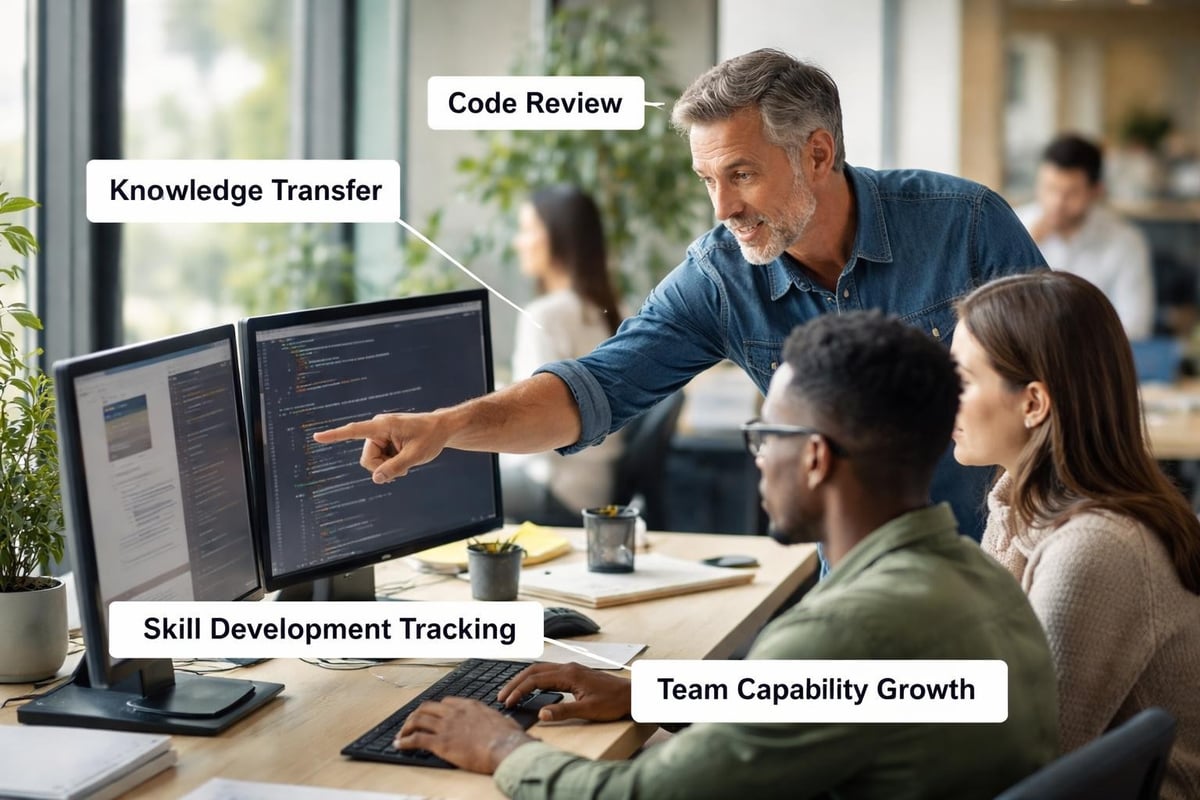
Technical Mentorship
Effective mentorship accelerates team capability development. Senior engineers mentor through:
- Code review feedback: Providing constructive, educational feedback that improves code quality and developer skills
- Pair programming sessions: Working directly with junior developers to demonstrate problem-solving approaches
- Technical documentation: Creating guides, architectural decision records, and onboarding materials
- Knowledge sharing: Leading tech talks, workshops, and architecture review sessions
This mentorship creates multiplicative value. A senior engineer who improves team capabilities delivers more impact than one who solely focuses on individual output.
Cross-Functional Collaboration
Senior engineers communicate effectively with non-technical stakeholders. They translate business requirements into technical specifications and explain technical constraints in business terms. This communication ability proves essential when working with product managers, designers, and executives who need to understand feasibility, timelines, and resource requirements.
For companies exploring software consultancy services, senior engineers serve as the primary technical liaisons, ensuring alignment between business objectives and technical implementation.
Problem-Solving and Decision-Making
A defining characteristic of sr software engineer effectiveness is systematic problem-solving capability. Senior engineers approach complex challenges with structured methodologies that lead to robust solutions.
Architectural Decision-Making
Every technology choice carries implications for system performance, development velocity, and operational costs. Senior engineers evaluate options using frameworks that consider:
- Performance requirements: Throughput, latency, and resource utilization targets
- Scalability needs: Horizontal vs. vertical scaling approaches
- Team expertise: Leveraging existing knowledge vs. learning curve for new technologies
- Ecosystem maturity: Library availability, community support, long-term viability
- Operational complexity: Deployment requirements, monitoring capabilities, debugging tools
These decisions require balancing competing priorities. The optimal choice for rapid prototyping differs from the best approach for enterprise-scale systems. Understanding these trade-offs separates senior engineers from less experienced developers.
Debugging Complex Systems
Production issues in distributed systems require methodical investigation. Senior engineers employ systematic debugging approaches:
- Reproduce the issue in controlled environments
- Analyze logs, metrics, and traces to identify patterns
- Form hypotheses about root causes
- Test hypotheses through targeted experiments
- Implement fixes that address underlying problems rather than symptoms
- Validate solutions through testing and monitoring
This systematic approach minimizes downtime and prevents recurrence. Senior engineers document their findings, creating knowledge bases that accelerate future troubleshooting.
Career Progression to Sr Software Engineer
The path to senior-level positions varies based on individual circumstances and organizational structures. However, certain patterns consistently emerge across successful career progressions.
Skill Development Timeline
Most developers require 5-8 years of professional experience before qualifying for sr software engineer roles. This timeline reflects the breadth of knowledge required:
Experience Level | Typical Timeline | Focus Areas |
|---|---|---|
Junior Engineer | 0-2 years | Language proficiency, basic algorithms, code implementation |
Mid-Level Engineer | 2-5 years | System design, testing practices, project ownership |
Sr Software Engineer | 5-8 years | Architecture, mentorship, technical leadership |
Staff/Principal Engineer | 8+ years | Organization-wide technical strategy, cross-team initiatives |
Accelerating this timeline requires deliberate practice. Developers who seek challenging projects, request feedback actively, and invest in continuous learning progress faster than those who remain within comfort zones.
Demonstrating Senior-Level Capabilities
Earning promotion to sr software engineer requires demonstrating capabilities before receiving the title. Developers can showcase readiness by:
- Taking ownership: Volunteering to lead complex projects that require coordination across teams
- Improving processes: Identifying inefficiencies and implementing solutions that benefit entire teams
- Teaching others: Creating documentation, leading workshops, and providing thoughtful code reviews
- Delivering impact: Shipping features that drive measurable business results
Organizations like Vicedomini Softworks often document these progression expectations in engineering ladders that provide clear advancement criteria.
Continuous Learning and Adaptation
The software engineering field evolves rapidly. Technologies that dominate today may become obsolete within five years. Sr software engineers maintain relevance through continuous learning strategies.
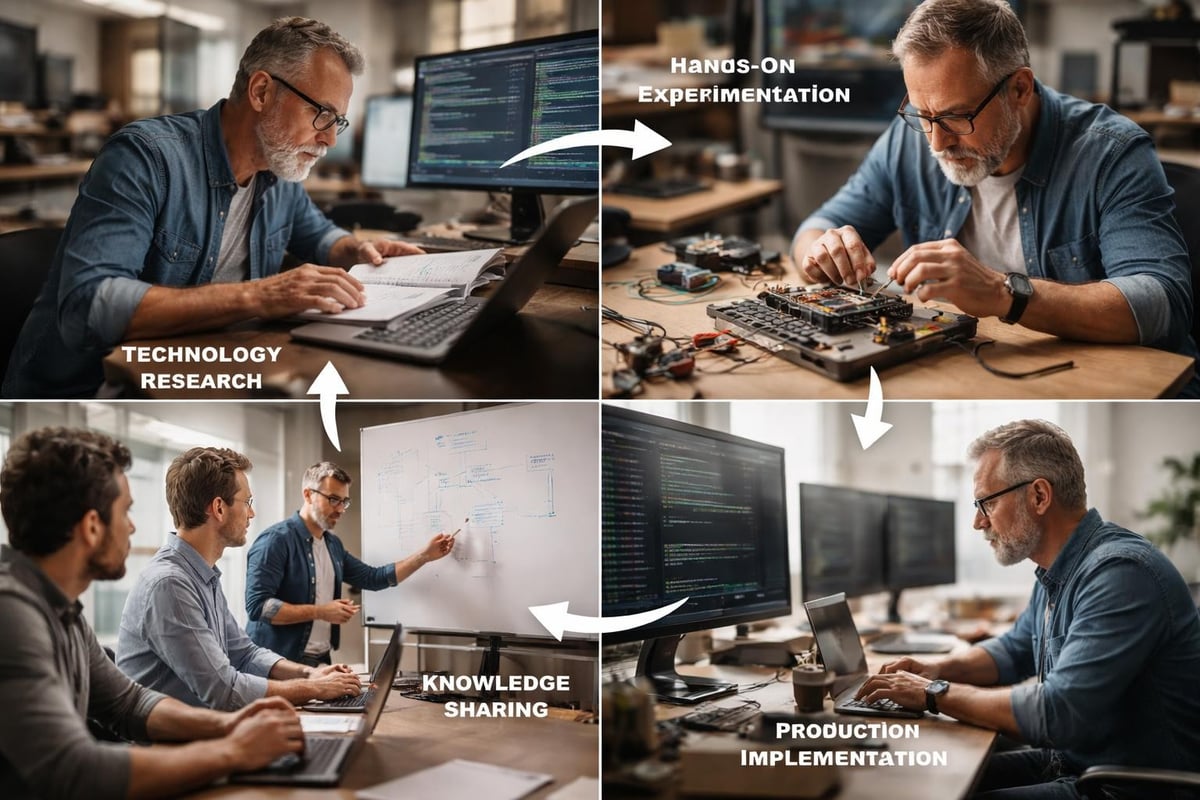
Staying Current with Technology Trends
Senior engineers balance depth in core technologies with awareness of emerging trends. This balance prevents both technological stagnation and constant tool-switching that disrupts productivity.
Effective learning strategies include:
- Following industry publications: Reading technical blogs, research papers, and conference proceedings
- Experimenting with new tools: Building side projects that explore emerging technologies
- Attending conferences: Participating in events that provide exposure to cutting-edge practices
- Contributing to open source: Engaging with communities that shape technology evolution
Platforms like Andrew J. Pyle provide structured learning paths for understanding AI integration, an increasingly critical competency for senior engineers working on modern applications.
Soft Skills Development
Technical expertise alone proves insufficient for sr software engineer success. Interpersonal skills significantly impact effectiveness:
- Communication clarity: Explaining complex concepts to diverse audiences
- Conflict resolution: Navigating technical disagreements constructively
- Time management: Balancing coding work with meetings, reviews, and planning
- Empathy: Understanding teammate perspectives and providing supportive feedback
Organizations like My Training Network offer specialized programs that develop these critical soft skills, recognizing that technical leaders require both engineering expertise and people management capabilities.
Measuring Sr Software Engineer Impact
Senior engineers contribute value that extends beyond lines of code written. Organizations measure senior-level impact through metrics that capture both direct contributions and team enablement.
Individual Contribution Metrics
Direct technical contributions remain important. Relevant metrics include:
- Code quality: Defect rates in shipped features, code review approval rates
- Delivery speed: Time from feature specification to production deployment
- System reliability: Uptime percentages, mean time to recovery for incidents
- Performance improvements: Measurable application speed or resource efficiency gains
These metrics provide baseline assessments but miss substantial senior engineer contributions.
Team Enablement Metrics
Senior-level impact manifests through team capability improvements. Organizations track:
Metric Category | Measurement Approach |
|---|---|
Knowledge Transfer | Documentation created, training sessions delivered, developers mentored |
Process Improvement | Build time reductions, deployment frequency increases, incident rate decreases |
Technical Debt Reduction | Refactoring initiatives completed, test coverage improvements |
Architecture Quality | System scalability increases, integration complexity reductions |
A sr software engineer who improves team velocity by 20% through better tooling delivers more value than one who individually completes 20% more features. These broader contributions define senior-level effectiveness.
Common Challenges and Solutions
Even experienced sr software engineers encounter obstacles that impede effectiveness. Recognizing these challenges and implementing solutions proves essential for sustained success.
Technical Debt Management
Every codebase accumulates technical debt. Senior engineers balance debt remediation with feature development by:
- Quantifying debt impact through metrics (build times, bug rates, developer velocity)
- Prioritizing high-impact refactoring that enables future feature work
- Incorporating debt reduction into regular sprint planning
- Documenting decisions to prevent similar debt accumulation
This systematic approach prevents debt from overwhelming development capacity while maintaining business feature delivery.
Scope Creep and Priority Management
Senior engineers often face competing demands from multiple stakeholders. Effective prioritization requires:
- Ruthless focus: Declining projects that don't align with organizational priorities
- Stakeholder communication: Explaining capacity constraints and trade-off implications
- Delegation: Identifying tasks that develop junior team members while freeing senior capacity
- Automation: Building tools that eliminate repetitive manual work
These strategies protect senior engineers from overcommitment while maximizing their strategic impact.
Maintaining Technical Skills While Leading
Leadership responsibilities can reduce hands-on coding time. Senior engineers maintain technical sharpness through:
- Reserving dedicated coding time for critical features or infrastructure work
- Contributing to open source projects outside work hours
- Participating in code reviews that expose them to diverse technical approaches
- Rotating through different system components to maintain broad knowledge
Understanding the balance between technical work and leadership activities determines long-term career satisfaction and effectiveness.
Industry-Specific Considerations
The sr software engineer role manifests differently across industries and organization types. Understanding these variations helps professionals target appropriate opportunities.
Startup vs. Enterprise Environments
Startup senior engineers often wear multiple hats, moving between infrastructure, backend, and frontend work as business needs dictate. They prioritize speed and flexibility over extensive documentation and process formalization.
Enterprise senior engineers typically specialize more narrowly but work within established frameworks. They navigate organizational politics, comply with security and compliance requirements, and coordinate across larger teams. The skills required for success differ significantly between these environments.
Remote vs. Co-located Teams
Remote work has become standard for many sr software engineer positions in 2026. This shift demands additional communication and collaboration capabilities:
- Asynchronous communication: Writing clear documentation and status updates that teammates can consume across time zones
- Video presence: Conducting effective technical discussions through video conferencing
- Self-motivation: Maintaining productivity without physical office structure
- Inclusive facilitation: Ensuring remote participants receive equal consideration in meetings
Organizations like Vicedomini Softworks that build distributed teams prioritize these communication skills during hiring and development processes.
Building a Sr Software Engineer Career
Achieving and sustaining success as a sr software engineer requires intentional career management. Professionals who advance most effectively combine technical excellence with strategic career planning.
Creating Career Development Plans
Structured development plans accelerate growth. Effective plans include:
- Skill gap identification: Comparing current capabilities against target role requirements
- Learning objectives: Specific skills to develop within defined timeframes
- Project selection: Choosing work that builds desired competencies
- Mentorship relationships: Identifying senior engineers who can provide guidance
- Progress measurement: Regular assessment of skill development and impact
These plans transform vague ambitions into actionable steps that drive measurable progress.
Building Professional Networks
Career opportunities often emerge through professional connections. Senior engineers build networks by:
- Contributing to open source projects that demonstrate expertise
- Speaking at conferences and meetups on specialized topics
- Writing technical blog posts that showcase problem-solving approaches
- Participating in online communities relevant to their technology stack
These activities establish reputation while creating opportunities for collaboration and career advancement.
Negotiating Compensation and Title
Sr software engineer compensation varies significantly based on location, industry, and company size. Understanding market rates enables effective negotiation.
Effective negotiation strategies include:
- Researching compensation data for specific markets and company sizes
- Documenting impact through metrics and specific accomplishments
- Timing discussions around performance reviews or project completions
- Considering total compensation including equity, benefits, and professional development budgets
- Maintaining professional relationships regardless of negotiation outcomes
These approaches maximize compensation while preserving working relationships.
The sr software engineer role demands technical mastery, leadership capability, and continuous adaptation to evolving technologies. Professionals who develop these competencies create significant value for their organizations while building rewarding careers.
Whether you're building internal engineering capabilities or seeking expert partners for custom software projects, Vicedomini Softworks delivers the senior-level technical expertise and strategic guidance that transforms ideas into production-ready digital products. Our team combines deep technical knowledge with practical delivery experience to help startups and established companies build scalable, maintainable solutions.